Postpartum Rage: What is it and Five Steps to Manage it Naturally.

updated: 9.3.25
Are you feeling angry after childbirth?
Postpartum rage is a real emotion felt by many moms after giving birth.
It can be a huge stressor on your body and your family.
I remember going for a run one day and screaming at the top of my lungs when I got home - my doe-eyed, twin one-year-olds staring at me with their eyes wide open. My late husband stood there, shocked.
I was so overwhelmed with raising twins and running a business. It was all too much.
Years later, I would discover why I had so much rage inside of me.
In this post, we will discuss why postpartum rage happens and what you can do about it.
10 Postpartum Rage Symptoms
Intense anger
Extreme irritability
Feelings of powerlessness
Excessive crying
Anxiety
Difficulty sleeping
Withdrawal from loved ones
Negative feelings or little interest in her baby
Loss of interest in daily activities
Feelings of worthlessness
“In Chinese medicine, they say your liver is the seat of anger. ”
So supporting your liver is part of the healing process.
But, let’s dig deeper.
How long does postpartum rage last?
It can last years, if you don’t learn how to metabolize these hormones, then it usually turns into PMDD, Premenstrual dysphoric disorder (PMDD); which occurs the two weeks before your period.
Do you have PMDD? Read this post:https://www.taragregorio.com/blog/pms-or-pmdd
Here are six studies I’ve found on my postpartum rage and anger.
In one study, they found that intense anger often stemmed from violated expectations, unmet needs, stress, exhaustion, and infant sleep issues. ¹
This anger is also connected to postnatal depression. ²
Trauma history significantly elevated the risk of anger—even after controlling for mental health symptoms, indicating anger's distinct role. ³
Scholarly work traces how modern Chinese medicine explicitly maps anger to the Liver system (the “General”), shaping diagnosis/treatment for irritability and rage-like states. ⁴
Histamine's effect on mood: As a stimulating neurotransmitter, histamine can directly affect the brain. Elevated levels can lead to mood disturbances, such as anxiety, agitation, irritability, and even rage. - Dr. Lara Briden ⁵
Feelings of anger and hostility have been most commonly associated with elevated levels of cortisol. Anger may be exacerbated with elevated cortisol or the “metabolic fuel” stemming from the HPA axis. ⁶
So, we need to address five pieces of your healing
Here are five steps to heal postpartum rage. Join the masterclass to learn more.
Step #1: Begin Expressive Writing
Step #2: Seek Community Support/ Exercise and Address Trauma
Step #3: Support Your Liver
Step #4: Prioritize Sleep
Step #5: Lower histamine and Cortisol
How long does postpartum rage last?
It can last a long time. It usually turns into really bad PMS and we just assume it cannot be healed and/or hate our period every month.
“You’ll want to address your liver health to support estrogen clearance - which in turn will reduce your anger. ”
What to do for postpartum rage?
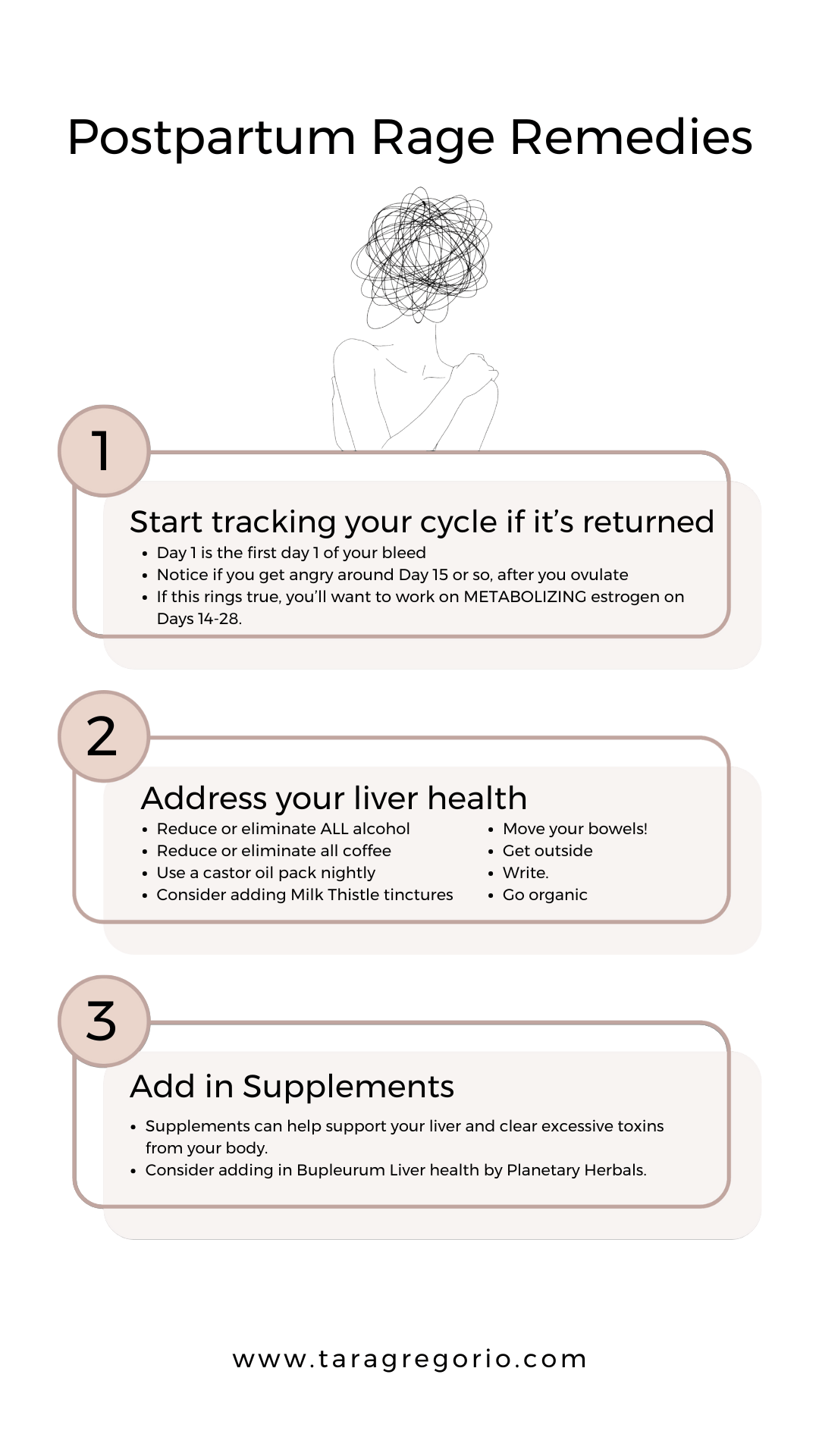
#1: Start tracking your cycle if it’s returned…
Day 1 is the first day 1 of your bleed
Notice if you get angry around Day 15 or so, after you ovulate
If this rings true, you’ll want to work on METABOLIZING estrogen on Days 14-28.
Additionally, you may want to take a DUTCH hormone test to see if your progesterone is low.
You can wait until six months postpartum for this.
Step #2: Address your liver health
Even if your doctor says “everything looks ok”, you want to support your liver each month.
What does that mean?
Reduce or eliminate ALL alcohol, as this can be taxing for your liver, affects your sleep, and makes you angry
Reduce or eliminate all coffee, or just one cup, before 12 pm
Use a castor oil pack nightly, especially the week before your period- I love Queen of Thrones! Apply this to the area under your right rib.
Add a heating pack for a soothing effect!
Consider adding Milk Thistle tinctures to your diet to support your liver.
Move your bowels! You don’t want to be constipated, as you’ll be holding on to toxins. Make sure you go 1-2x a day. Here are some constipation tips:https://www.taragregorio.com/blog/10-ways-to-reduce-constipation
Get outside, get some sunshine, walk in the grass barefoot - do something fun!
Write.
The Postpartum Rage Masterclass has 17+ writing prompts to uncover why you’re so angry.
Go organic and use clean cleaning supplies to reduce your exposure to xenoestrogens.
Step #3: Add in Supplements
Supplements can help support your liver and clear excessive toxins from your body.
Consider adding in Bupleurum Liver health by Planetary Herbals.
Please note: This is not safe if you’re breastfeeding. The combination helps support your liver health.
We want botanicals to lower your cortisol, lower your excessive estrogen, calm your nervous system, and support your liver.
5 Herbs to Lower Your Cortisol
#1 Passionflower
When you feel your anger rising and your thoughts are circling, consider Passionflower.
It's an excellent herb to use when you need quality sleep, but don't want to feel sleepy and need to get things done!
Dosing:
Drink 1-2 cups of blended tea, 2 hours before bed to prevent night waking.
Before bed, take 20-30 drops of the tincture in 1/4 cup of water.
Breastfeeding safety: It's considered an L1/2 safe by the German Commission E
#2 Ashwagandha- Withania somnifera
To support sleep and induce relaxation, the Ashwagandha supplement is for you. Keep in mind, it is warming and drying, so it may not be best for those in perimenopause or with hyperthyroidism.
Dosing: I prefer the supplements with KSM-66, like Seeking Health found here.
Breastfeeding Safety: Safe. In Ayurvedic medicine, ashwagandha is traditionally used to promote lactation (Kapoor 1990)
#3 Lemon Balm - Melissa officinalis
Lemon balm tea or tincture has been known to lift your mood and induce happiness.
Dosing: Taken as tea or a tincture.
Breastfeeding Safety: Safety Class 1 and Interaction Class A. Considered safe while breastfeeding, it may change the taste of the milk as it is part of the mint family.
Botanical Safety handbook does state, no information on safety has been identified for pregnancy or during lactation.
#4 Blue Vervain
To reduce tension and stress.
Dosing: 20-30drops of a tincture; 2-3x day
Breastfeeding Safety: There is no data from the German Commission E on Blue Vervain’s safety. The botanical safety handbook considers it a Safety Class 2b; not to be used during pregnancy. Safety during lactation has not been established.
#5 Lavender
To reduce tension and stress
Dosing: Less is more. 1-5 drops of a tincture may be nice or add a sprinkle to your cup of chamomile tea.
Breastfeeding Safety: It's considered an L1/1 safe by the German Commission E
Herbs to Support Your Liver Health
#1 St. John’s Wort for Postpartum Rage
If your rage is due to high estrogen levels, St. John’s Wort can help clear them out of the body.
Dosing: Take as a tincture, 20-30 drops; 2-3x a day or as a supplement
Breastfeeding safety: Considered an L2/L3 safer and moderately safe by the German Commission E.
See my YouTube video on my St. John's Review
#2 Vitex agnus-castus L. {chaste tree}
If your cycle is off in days, Vitex can help balance and regulate it so it goes back to your normal length. Caution: Vitex is known to create an increase in depression in those with low estrogen**
Dosing:
Typical dosing is 20-40 mg/day, though up to 240 mg of herb products is safe and effective.
Tincture or liquid extract is taken in doses of 20-40 drops up to 3 times/day, and some herbalists recommend as much as 1 measured teaspoon (= 5 mL) per day, either all in one dose in the morning or divided into 2 or 3 doses throughout the day.
Notes: Not to be used with hormonal contraceptives and watch for worsening depression.
#3 Milk thistle- Silbum marianum
Milk thistle extract for the liver
If you get pain on the right side of your body or know you want to support your liver, milk thistle can help.
Dosing: 10-30 drops; 2-3x day as a tincture
Breastfeeding Safety: Safety Class 1, Interaction Class A. No adverse effects were reported from nursing mothers. (Di Pierro et al 2008)
Caution: It may modify your glucose levels, so monitor your blood sugar when using it, or notice if you’re craving more sugar. You may need to discontinue if you are.
#4 Bupleurum spp.
Known for its smooth flow of energy, it may help ease anger, irritability, or frustration.
Dosing: See suggestions on packaging.
Breastfeeding Safety: Safety Class 1, Interaction Class A. Although there are no concerns about using bupleurum in pregnancy or during lactation, safety has not been established.
What helps postpartum rage?
The supplement that helped me was the Planetary Herbals Liver Cleanse.
Keep in mind that it’s not to be used during breastfeeding.
Along with addressing your liver health, any previous trauma, and nervous system regulation. Your body can heal from postpartum anger and rage.
Postpartum Depression Rage
I found that when I had a “breakthrough” with depression, the rage set in monthly, which points more to something called PMDD. This may not happen to everyone, but it was my experience.
Conclusion
By addressing your liver health and supporting your detoxification pathways, you can heal your postpartum rage naturally.
Additionally, consider getting tested for the MTHFR gene to see if you need a methylated B vitamin to support your detoxification and eliminate rage and anxiety.
xo Tara
P.S. Have questions? Let me know in the comment area below.
Sources
¹ https://journals.sagepub.com/doi/full/10.1177/10497323221120173 ↩
⁵ https://www.larabriden.com/the-curious-link-between-estrogen-and-histamine-intolerance ↩
More Reading