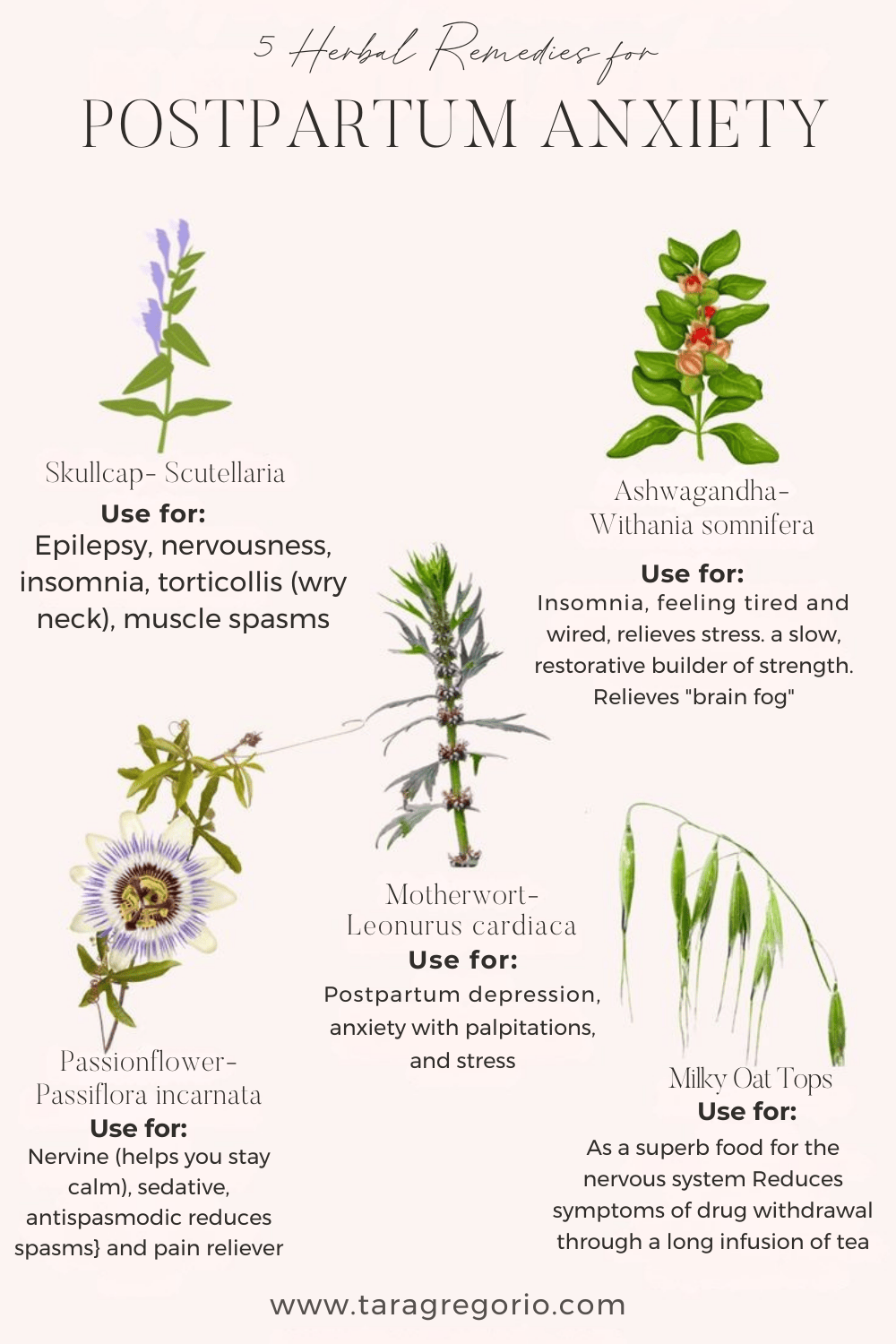
5 Herbal Remedies for Postpartum Anxiety

Are you feeling overwhelmed with motherhood?
Is your heart pounding?
When you lie down at night, do your thoughts keep you up?
These are signs of postpartum anxiety - even if you’re not sure if you’re postpartum anymore.
In this blog post, I’ll cover my five favorite herbal remedies for postpartum anxiety, along with breastfeeding safety.
So, let’s begin!
What is postpartum?
“Post” means after, “Partum” after childbirth. So, even if your children are 10 or you’ve had a miscarriage, you’re considered postpartum by some doulas, midwives, and herbalists. The medical community and society have led us to believe that after six weeks, we should feel like ourselves again.
==But, the truth is, when we don’t methylate well after birth, our body becomes “triggered” by the excessive folic acid, low progesterone, and heavy metals in our body, creating depression and anxiety that last for many years after childbirth. source. source. source
In this post, I’ll cover my five favorite herbal remedies for postpartum anxiety and the breastfeeding safety of each, so you can get started on calming your nervous system.
Keep in mind that herbal medicine can help you feel calm, but it’s only one step in your healing process.
We also want to address your diet, nutrient deficiencies, nervous system regulation, hormone levels, and even low amino acids.
Let’s get started.
Skullcap while breastfeeding
Skullcap- Scutellaria
Historically used for:
Epilepsy, nervousness, insomnia, torticollis (wry neck), muscle spasms
Modern uses
Use for a tight neck or jaw
If you’re nervous or agitated with spasms, tics, or tight muscles
If your legs keep moving at night (a.k.a. restless leg syndrome}- this could also be low magnesium, mild Tourette’s, and grinding of the teeth
It will not make you sleepy, so using it during the day is ok
Dosing:
I prefer adding Skullcap to The One Tea blend- I suggest all mothers drink
You can drink it as a tea or use drops of tincture in your water to stay calm during the day
Alternatively, you can drink 1-2 cups of tea before bed. Remember that drinking tea 2 hours before bedtime can help reduce the need to go in the middle of the night.
Or you can take 20-30 drops of the tincture in 1/4 cup of water before bed.
Breastfeeding safety:
It's considered an L1/2 safe by the German Commission E
2. Ashwagandha - Withania somnifera
Historically Used:
The Ayurvedic medical system is used for premature aging. Dubbed the “Indian ginseng.”
Gives you the strength and stamina of a stallion
Made as a decoction with the root
Used as an adaptogen to relieve stress
Slow, restorative builder of strength
Relieves “brain fog.”
Energy
Bitter, warm & dry
So if you tend to be cold, this may be a good choice for you.
Dosing and Safety:
Herbal Tincture or Extract
You can take 30-40 drops, up to 3x a day
But! If it doesn’t work for you or makes you anxious, try the powder or capsules.
Capsules
400-500 mg capsule; 2x day
Powder
Traditionally, in India, Ashwagandha was taken in warm milk with ghee at night for sleep or to increase milk supply.
Take 1 tsp. in warm milk with ghee at night to aid sleep.
* Powder Dosing: 1 tsp. Withania powder may be given 2x day with milk for insufficient lactation. ³
>>Always start with a small amount to see how you and your baby respond if you’re breastfeeding!
Ashwagandha: Who should not take
David Winston suggests:
Avoid using the herb if you're sensitive to plants in the nightshade family - but this could be a case-by-case situation.
He also states: not to use the powder internally if you have excess iron.
And, if you have hyperthyroidism, you may want to avoid this botanical, as Ashwagandha can increase T4 and maybe T3.
Ashwagandha When Pregnant
David Winston also suggests avoiding it during pregnancy. Still, Mills & Bones consider it a Category B1: Studies in animals have not shown evidence of an increase in the occurrence of fetal damage. So, it's a bit confusing if you're pregnant and want to try Withania.
Additionally, caution may be needed if you have autoimmune conditions, as it can increase T1 activity.
#3 Passionflower-Passiflora incarnata
Historically used for:
Nervine {help you stay calm}, sedative, antispasmodic {reduce spasms} and pain reliever
Modern uses
Think of the monkey mind, and you can’t shut your thoughts off at night
Painful spasms of a tight pelvic floor
Use during the day
Use for:
Pelvic pain and fibroids
When you feel anxious, stressed, and tense
Matthew Wood states that it actually increases concentration during wakefulness by “cutting out internal chatter”
It's an excellent herb to use when you need quality sleep, but don't want to feel sleepy and need to get things done!
Dosing:
Drink 1-2 cups of blended tea, 2 hours before bed, to prevent night waking.
Before bed, take 20-30 drops of the tincture in 1/4 cup of water, or you can try taking it throughout the day.
Passionflower While Breastfeeding
Breastfeeding safety: It's considered an L1/2, safe by the German Commission E
4. Motherwort- Leonurus cardiaca- “The heart of a lion”
Historically Used for:
Postpartum depression, anxiety with palpitations, and stress
Modern uses;
The #1 remedy for heart palpitations
Better for hyperthyroidism,
Very bitter, so you may want to take it as a combined tincture
Carry a tincture with you at all times if you get panic attacks!!!>> You can take it during a panic attack or to prevent one
Dosing:
Take 20-30 drops of the tincture in 1/4 cup of water as needed for anxiety.
I added this to my water bottles when I was very anxious driving
Motherwort While Breastfeeding
Breastfeeding safety:
It's considered an L1/2 safe by the German Commission E- Safe.
But not to be used during pregnancy
#5 Milky Oat Tops
Historically used for:
As a superb food for the nervous system, think of starting your day with oatmeal and lots of protein
Reduces symptoms of drug withdrawal through a long infusion of tea
Modern uses
Nervous exhaustion, PMS, withdrawal from coffee, cigarettes, and drugs
Chemical sensitivities
Panic disorder
If you feel like a “hot mess,” this may be for you
Dosing and Safety:
Take daily as a nourishing tea, steep for 4-8 hours, to soothe anxiety, and works well with Stinging nettles.
Milky Oat Tops While Breastfeeding
Breastfeeding Safety
Level 1, Safe while breastfeeding.
I love using herbal teas and tinctures to help nourish and calm the nervous system during the postpartum period.
I also love homeopathy.
When you have anxiety, addressing your sleep should be your #1 priority.
Watch this video on how I use homeopathic remedies to support fear and anxiety during sleep: https://youtu.be/k18xDFEzVC8?si=911Jjsxy8Nc6bN4Q
Can you take these herbal remedies with SSRIs?
Yes, you can take most herbal remedies while taking SSRIs. St. John’s wort is the #1 botanical to be careful with SSRI interaction.
The best medication for postpartum anxiety
The best medication is getting to the root cause of your anxiety. In my online course, The Present Momma, we dive into five pieces of healing
Diet
Supplements
Herbal and Homeopathic Remedies
Nervous System Regulation
Gut healing
It takes a comprehensive approach to heal postpartum anxiety naturally.
Conclusion
Your body has a great capacity to heal anxiety after birth when you integrate natural remedies. It’s never just one botanical that will heal you. We have to address your nutrient gaps and fill them with supplements and herbal remedies first.
Which botanicals have you tried? Let me know in the comment area below.
xo
Tara
Resources
American Herbal Products Associations; Botanical Safety HandbookHales
Medications and Mother’s Milk: https://amzn.to/35XZFq5- more about conventional medication and nursing
Bone & Mills: Principles and Practice of Phytotherapy
Aviva Romm: Botanical Medicine of Women’s Health- Categories from the German Commission E. {see below}Brinker, Francis: Herbal Contraindications and drug interactions
https://www.taragregorio.com/blog/ashwagandha-while-breastfeeding
https://thebreastfeedingmama.com/natural-remedies-for-anxiety-while-breastfeeding/
https://www.taragregorio.com/blog/3-reasons-ashwagandha-is-not-working-for-your-postpartum-insomnia
https://www.medicalnewstoday.com/articles/postpartum-recovery
https://www.womenshealthmag.com/health/a28221402/postpartum-anxiety/
https://www.taragregorio.com/blog/better-than-zoloft-9-herbal-remedies
https://www.taragregorio.com/blog/8-common-postpartum-depression-and-anxiety-mistakes
https://www.sciencedirect.com/science/article/abs/pii/S0013935121015772
https://www.tiktok.com/@garybrecka.shorts/video/7275111857470459179